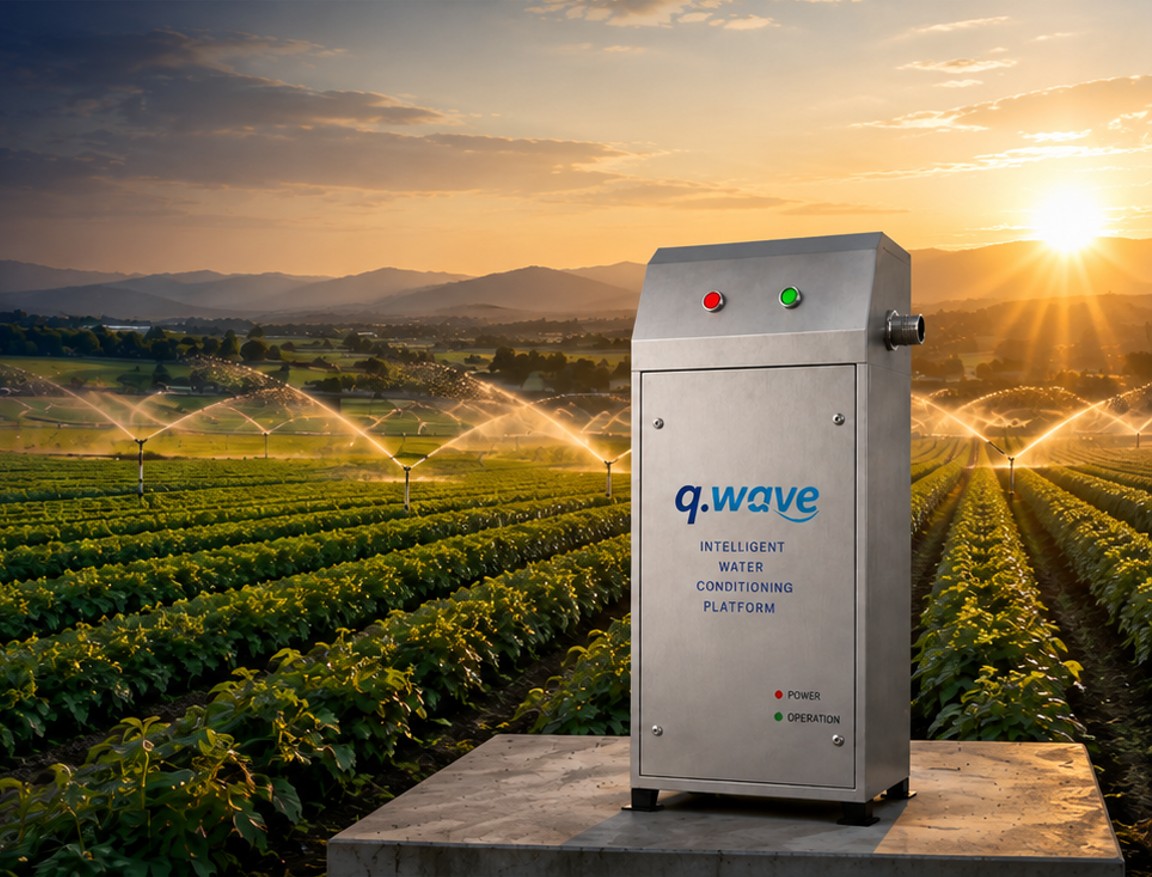
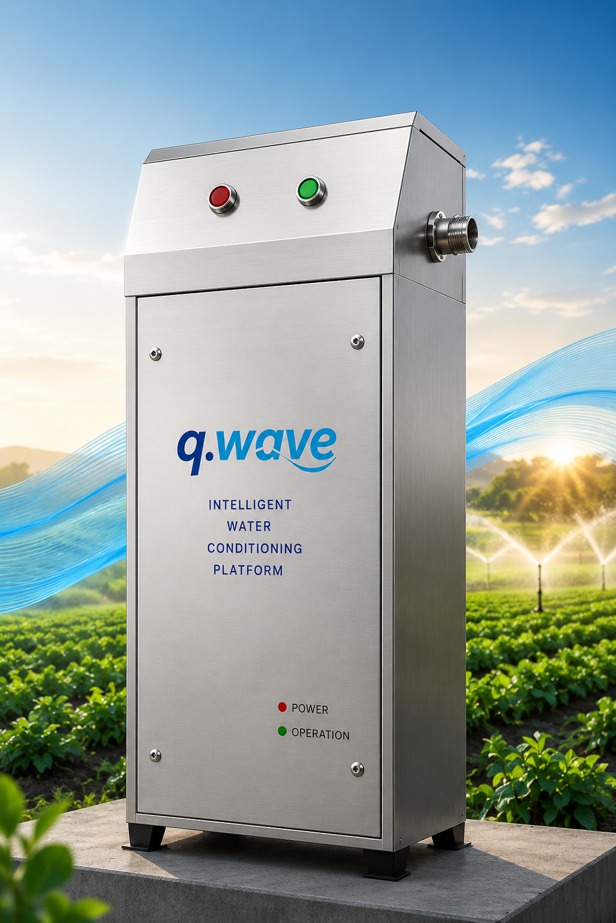
Pipe size is the starting point. From there, we look at your flow rate, water source, crop, irrigation system, and site conditions to configure the right q.wave system for your application.
QW-100
1″
Small Systems
Small greenhouses, residential applications, gardens, and small-scale irrigation.
Intelligent Controller · Customized Treatment Cartridge · Factory-Assembled System
Every q.wave system is configured around the actual operating conditions of your site. Final configuration is based on pipe size, flow rate, water source, application, and installation conditions.
Every q.wave model is built around the same intelligent water conditioning technology. The pipe size may change, but the way q.wave senses, controls, and conditions water stays the same.
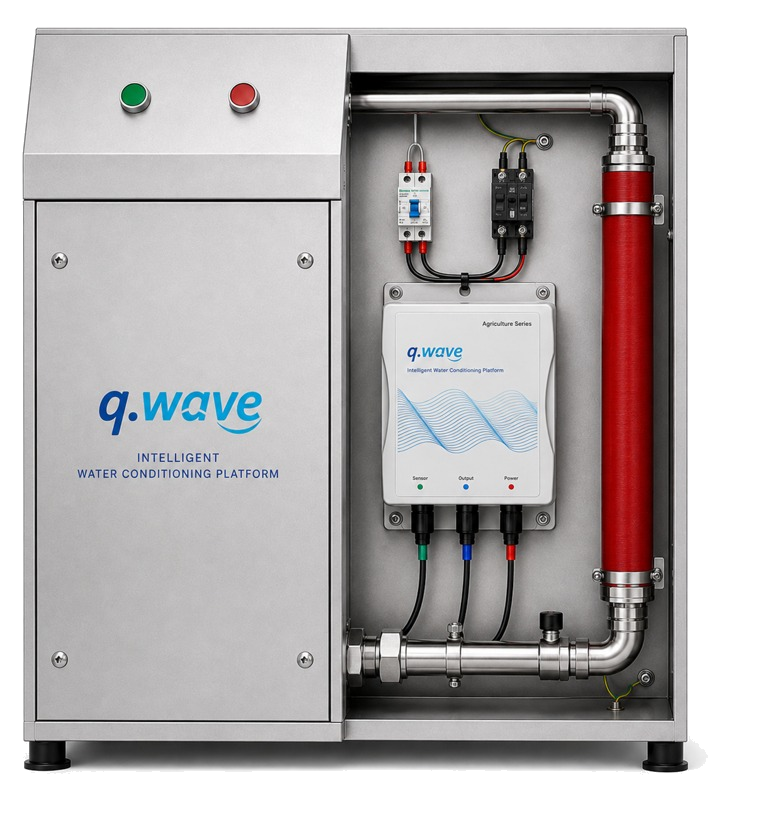
Intelligent Controller
The brain of the system. It uses sensing data to create and continuously adjust the conditioning signal.
Sensing System
Continuously monitors the water and operating conditions, providing real-time information to the Controller.
Coil Treatment Zone
Carries the controlled signal into the treatment zone, where the coil and cartridge work together.
Customized Treatment Cartridge
Filled with selected mineral media and matched to the water source, crop, and application.
Stainless-Steel Cabinet
Brings the Controller, sensing, power, coil, cartridge, and piping together in one complete system.
The Controller creates the signal. The coil delivers it. The cartridge completes the Treatment Zone.
Certification
KC EMC Certified
q.wave's Embedded Digital Processing Controller has successfully completed Korea's required Electromagnetic Compatibility (EMC) testing.
Maximum Internal Operating Frequency1.5 kHz — verified during KC EMC certification
Conducted EmissionsPASS
Radiated EmissionsPASS
Electrostatic Discharge (ESD)PASS
Electrical Fast Transient (EFT)PASS
Surge ImmunityPASS
RF ImmunityPASS
Detailed technical specifications and test information are available in the q.wave Gen 2 Engineering Manual.
Download Engineering Manual (PDF) →
Environmental Design
Designed with Environmental Responsibility in Mind
q.wave is designed to condition water without relying on added treatment chemicals or heat. Its non-chemical conditioning approach is intended to support more efficient water management while helping reduce dependence on conventional chemical treatment.
01
No Treatment Chemicals Added
q.wave does not add treatment chemicals to the water as part of its conditioning process.
02
No Heat Applied
The conditioning process does not rely on heating the water.
03
No Chemical By-Products
q.wave's signal-based conditioning process does not itself generate chemical treatment by-products.
04
Designed with U.S. Environmental Practices in Mind
The platform is being developed with consideration for applicable U.S. environmental requirements and EPA-related water management practices relevant to its intended applications.
Site-Customized Cartridge
Same Size. Different Water.
Two farms can use the same size pipe and still have very different water, crops, and operating conditions. That's why q.wave doesn't use the same cartridge everywhere. The mineral media inside each Treatment Cartridge is selected and tailored to the water source, application, and site conditions.
01
Agriculture
Greenhouses · Vegetables · Berries · Field Crops
02
Orchard
Citrus · Grapes · Fruit Trees
03
Turf
Golf Courses · Turf · Landscape Irrigation
04
Industrial
Cooling Towers · Boiler Systems · Process Water · Industrial Water
Each cartridge starts with the application, then is shaped around the water and site.
Pipe size determines the model. Water and application determine the cartridge.
How the System Comes Together
Custom-Built. Just Plug It In.
01
Site Information Review
Pipe diameter
Max. and typical operating flow rate
Water source
Crop or applicable industry
Irrigation and piping configuration
Installation environment
Power and independent earth ground conditions
02
Model Selection
Selects the base model — 1″, 2″, 3″, 4″, or 6″ — for your site.
03
Cartridge & Treatment Zone Design
Builds the cartridge and coil section around your crop, water quality, and goals.
04
Integrated Cabinet Build
Controller, sensors, power supply, piping, coil, cartridge — assembled and tested inside the cabinet.
05
Field Installation
Connect IN / OUT to your piping, connect power and ground, and you're done.
Site Review → Model Selection → Custom Build → Ready to Install
Installation
Fits Your System. Installs in Four Steps.
Your q.wave system arrives fully assembled and configured for your site, with IN / OUT connections sized and oriented for your piping layout. On site, installation comes down to four simple steps.
01
Position the Cabinet
Place and secure the q.wave cabinet at the designated installation point.
02
Connect IN / OUT Piping
Connect the q.wave inlet and outlet to your existing water line.
03
Connect Independent Earth Ground
Connect the system to the designated Independent Earth Ground.
04
Connect Power
Connect the power supply and the system is ready for commissioning.
IN / OUT Configured for Your Site
Left, right, top, or bottom — the IN and OUT connections can be arranged to match your piping layout and available installation space, whatever the site calls for.
Configured at the factory. Connected at the site. Ready to operate.
Power Flexibility
No Grid Power? No Problem.
Many farms don't have reliable access to grid electricity. q.wave is built to work anyway — with a solar-powered setup for fully off-grid operation, or right alongside an existing diesel-powered irrigation pump. Wherever your water comes from, q.wave can be installed.
01
Grid Power
Connects directly to an existing electrical supply — the simplest setup where grid power is already available.
02
Solar / Off-Grid
Runs on a solar array and battery system, with no dependence on grid power at all — built for remote sites.
03
Diesel-Pump Irrigation
Installs alongside diesel-powered irrigation pumps — q.wave runs on its own solar and battery system, so no changes are needed to your existing pump setup.
This is a complete solution regardless of your site's power situation — see it in action on a real off-grid solar installation in our case studies →
Need Help Choosing?
Not Sure Which Model? Let's Find Out.
Start with what you know. Tell us about your pipe size, water source, flow rate, and application. We'll review the site conditions and help identify the right q.wave configuration.